
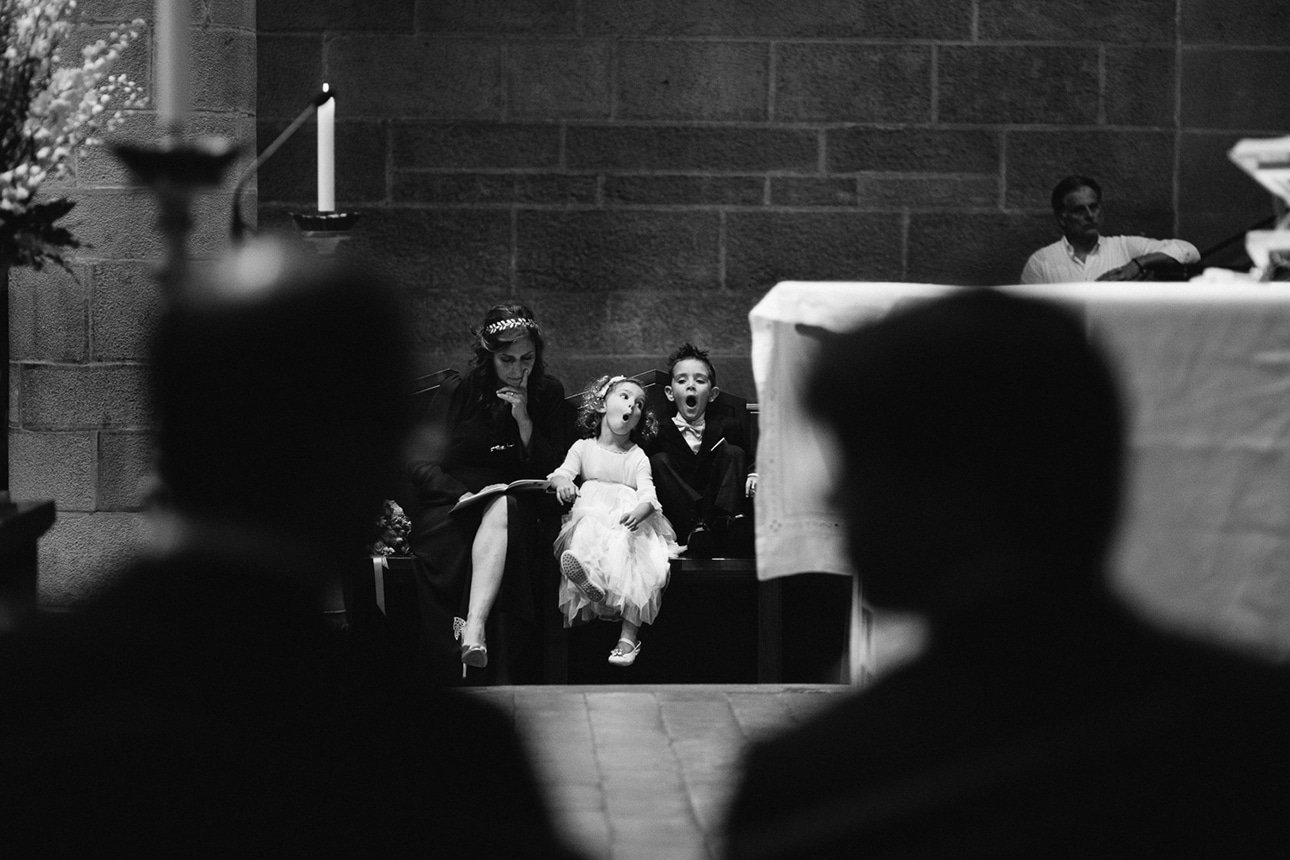
A practical guide
Getting married in Tuscany: a practical guide for foreign couples
This guide covers what foreign couples usually need to know before planning a wedding in Tuscany: where to look, when to come, how far ahead to book, which kind of ceremony to choose, and how to plan the day around the heat, the light and the weather.
Where · Getting there · When · Travel in Italy · Booking · Light · Food & wine · Ceremony
Where
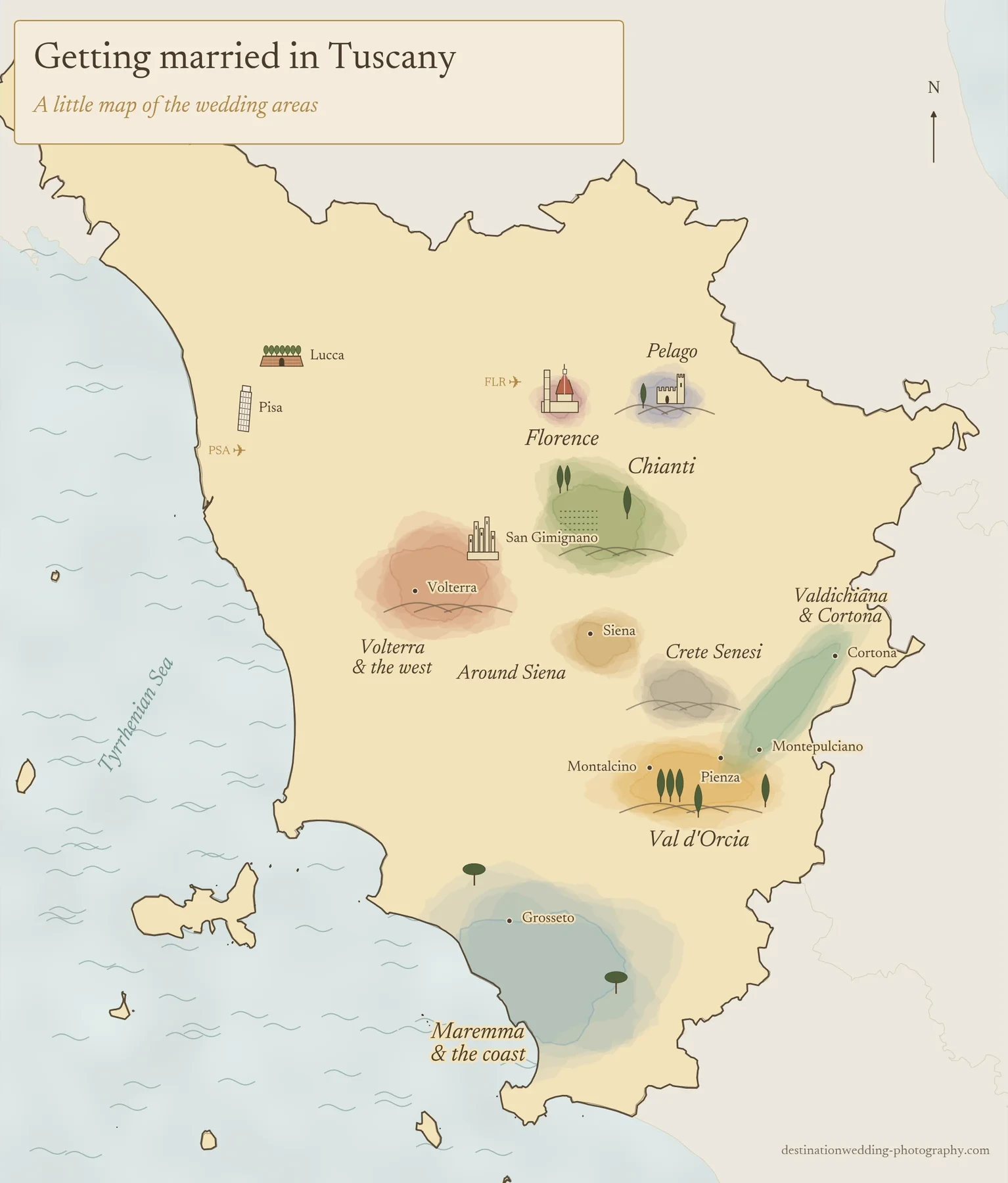
Where to get married in Tuscany
Whatever kind of wedding you have in mind, you’ll find the right place for it in Tuscany. There are hundreds and hundreds of venues, from historic villas and castles to farmhouses, wine estates, monasteries and private houses rented just for a few days.
The hard part isn’t finding a beautiful place: it’s choosing the area that suits you, because each part of Tuscany has its own landscape, its own light and its own pace.
A note on this guide
This isn’t a complete guide to Tuscany, and it doesn’t try to be. It comes from years of photographing weddings here: the places I know, the roads I’ve driven, the light I’ve worked in.
There are hundreds of beautiful venues and corners of the region that aren’t mentioned, and many of them would deserve a place on this page.
If you’re planning your wedding and have a question, about an area, a venue, the timing of the day or anything else, write to me and I’ll do my best to answer.
And if you think something is missing, tell me: I’ll be glad to add it, so the guide grows a little with every couple who reads it.
Practical notes
Getting there
Airports
Florence and Pisa are the closest. Florence airport is small and mainly served by European flights; Pisa is larger, with more low-cost connections. Rome Fiumicino has the best intercontinental connections and is about two to three hours by car from the Val d’Orcia and Siena.
Bologna is another good option for the north of Tuscany and the Chianti.
Many guests from the United States fly into Rome, or connect through a European hub to Florence or Pisa.
Trains
High-speed trains link Rome and Florence in about an hour and a half. For the Val d’Orcia and Montepulciano, the closest station on that line is Chiusi-Chianciano Terme.
Siena is reached by regional train from Florence. Trains are good for getting close, but from the station you’ll still need a car or a transfer.
Renting a car
A car gives guests the freedom to explore before and after the wedding.
Drivers with a licence from outside the EU usually need an International Driving Permit.
Limited traffic zones
Most historic town centres, including Florence, Siena and Pienza, are limited traffic zones (ZTL): driving in without a permit means a fine that arrives by post months later.
Park outside the walls and walk in.
Driving times
Florence to Siena is about one hour and ten minutes, Siena to Pienza or Montalcino about one hour, and Pisa to Siena about an hour and a half. Distances look short on the map, but country roads are slow and winding, and the last stretch to many villas is a gravel road.
Guest transport
Taxis are rare in the countryside and ride-sharing apps barely work outside the cities. A shuttle, or a few private drivers, between hotels and venue is the norm, and it means nobody has to drive after dinner.
Book it early: in May, June and September the good companies fill up fast.
The areas
Tuscany, area by area
Countryside or city?
Countryside
In the countryside, everything usually happens in one place. Guests stay at the villa or nearby, the ceremony, dinner and party are a few steps apart, and the day flows without moving anyone.
You get space, privacy and the landscape, but you’ll need to organise transport for guests, plan for the heat and think about a plan B for rain.
City
In a city like Florence, Siena or Lucca, the setting is history itself: a civil ceremony in a medieval town hall, portraits in squares and narrow streets, hotels and restaurants within walking distance.
On the other hand, there are crowds in high season, limited traffic zones and stricter rules on music and evening events.
Or both
Many couples combine the two: a ceremony in town, sometimes the day before, followed by dinner and the party in a villa in the hills just outside.
A small civil ceremony at the town hall with your closest family, then a long day in the countryside with all your guests: you get the history of the city and the space of the villa, without rushing from one to the other.
Val d’Orcia
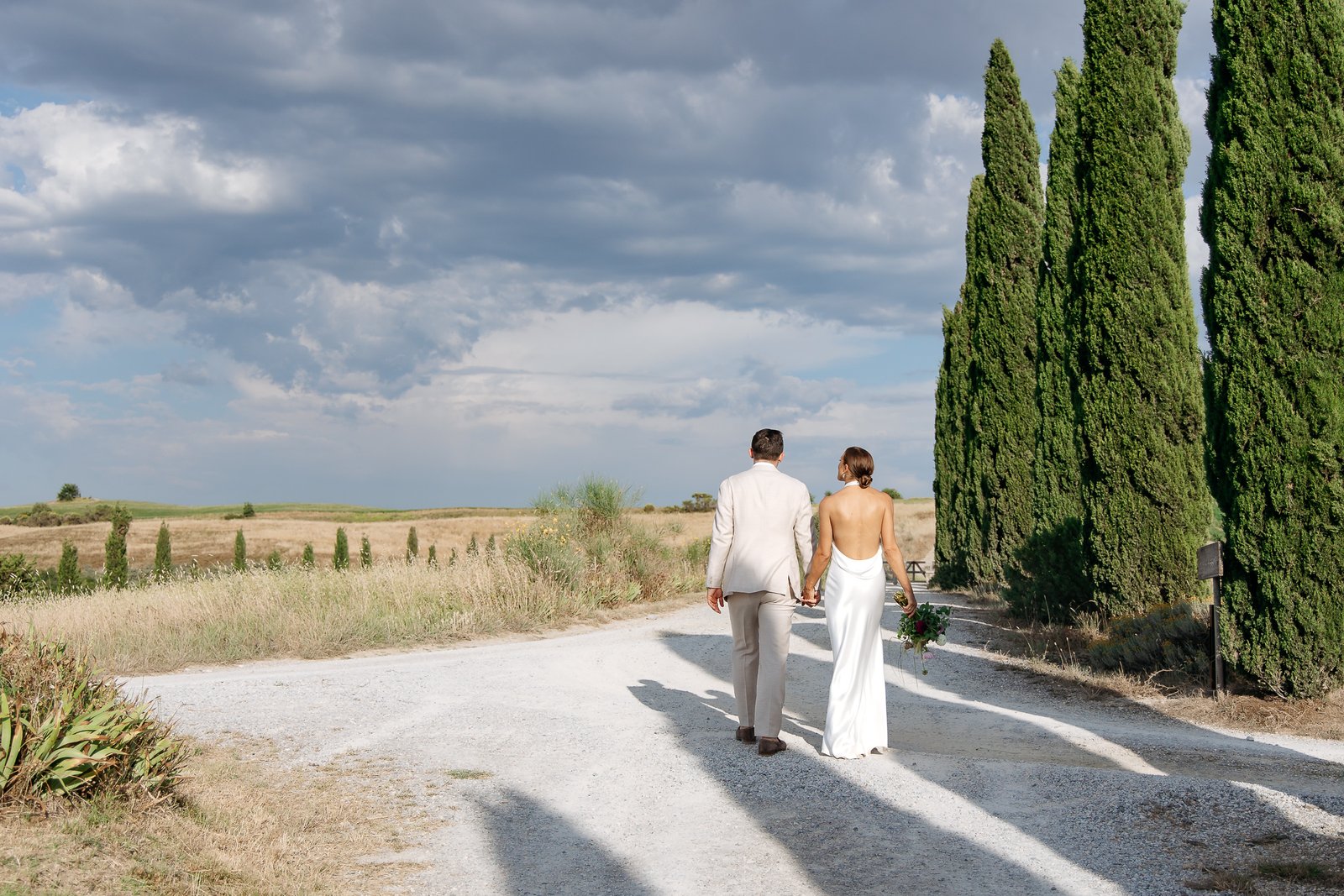
South of Siena, the Val d’Orcia is the Tuscany of postcards and a UNESCO World Heritage Site: rolling hills, lines of cypresses and small hill towns like Pienza and Montalcino.
Venues are mostly historic estates and agriturismi (working farms that also host guests, often with their own wine, olive oil and food), like La Foce, Terre di Nano and Il Rigo.

Around Siena
The hills just outside Siena hide some of the most elegant villas in Tuscany, with formal Italian gardens, lemon trees in terracotta pots and wide views over the countryside.
Siena itself is twenty minutes away for portraits, dinners or a day of sightseeing, and the Chianti begins just north of the city.

The Crete Senesi
Just south-east of Siena, the Crete Senesi are made of bare clay hills, grey and pale in summer and green after the rain, with an almost lunar feeling.
Isolated farmhouses, rows of cypresses along the ridges and the abbey of Monte Oliveto Maggiore. Quieter and less known than the Val d’Orcia, with small villages like Montisi.

Chianti
Between Florence and Siena, the Chianti is greener and more wooded than the south: oak and chestnut forests, vineyards on every slope, stone villages like Greve, Radda and Castellina, and castles turned into wine estates.
A good choice if you want wine at the centre of the day, and Florence within an hour.

Valdichiana and Cortona
To the east, the Valdichiana is a wide, fertile valley between Montepulciano and Cortona, with gentler hills, farmland and villas surrounded by parks, like Villa Castelletto near Sinalunga, and medieval villages like Gargonza.
Cortona, high on its hill, overlooks the whole valley and Lake Trasimeno.
Volterra and the west
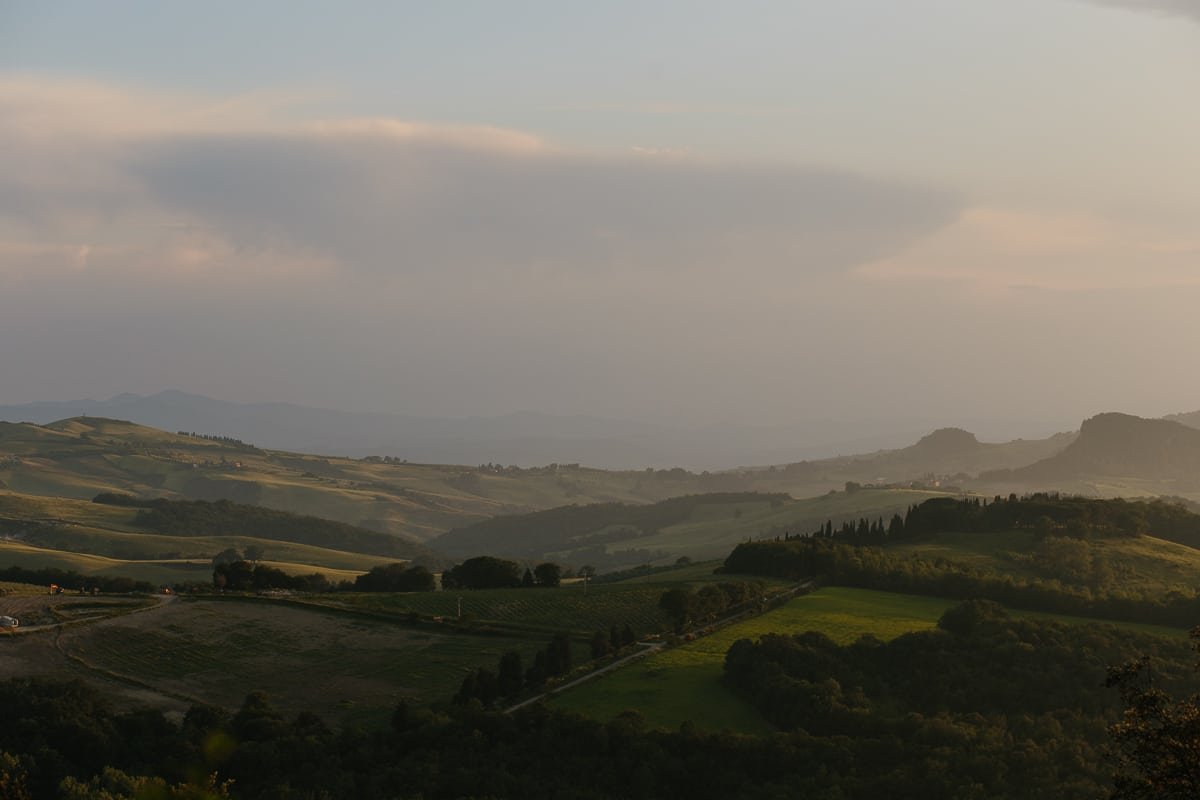
Around Volterra, an ancient Etruscan town known for its alabaster, the landscape opens up and becomes wilder and emptier, with long views towards the sea.
Fewer tourists, large estates and a real sense of space, with San Gimignano and its towers not far away.

Maremma and the coast
In the south-west, the Maremma combines the sea with a rougher countryside of woods, hot springs and hilltop villages like Montemerano.
For couples who want a beach or the sea nearby, it’s the most natural choice in Tuscany, with the Argentario and its coves within an hour’s drive.

Florence
For a city wedding, Florence offers historic palaces, churches and the town hall in Palazzo Vecchio, with the hills of Fiesole and San Miniato a few minutes away for portraits and dinner.
It’s also the easiest base for guests, with hotels, restaurants and fast trains to the rest of Italy.
Still deciding?
Not sure which area?
Tell me your date and the kind of day you have in mind. I’ll be happy to share what I know about the places you’re considering.
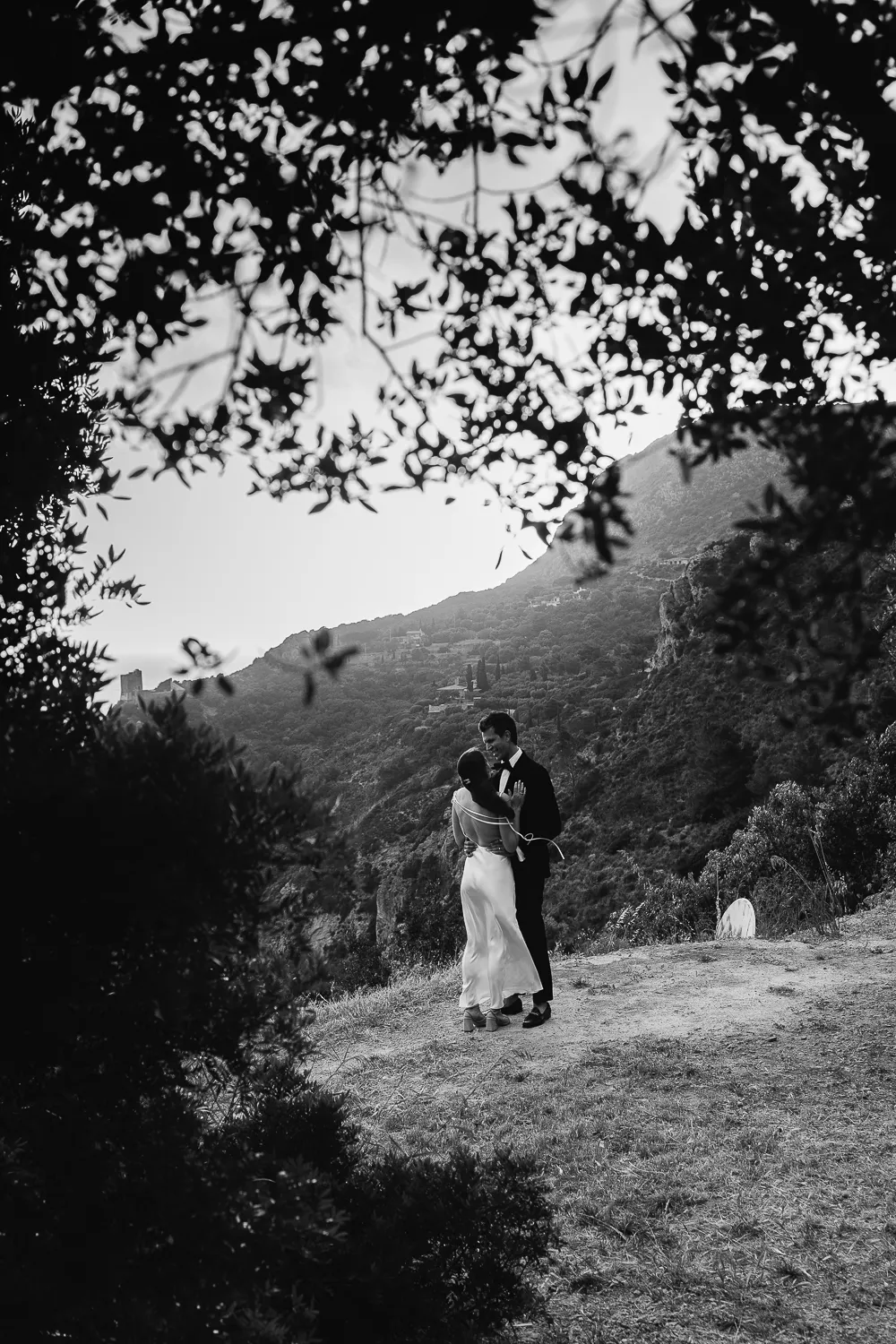
When
The best months to get married in Tuscany
May, June and September are the most requested months.
Days are long, evenings are mild, and the countryside is green in spring and golden in late summer.
July and August are very hot, especially in the Val d’Orcia, where temperatures above 35°C are common.
Late afternoon ceremonies, around 5 or 6 pm keep guests comfortable.
August is Italy’s holiday month. Schools close in June and reopen in September, and many factories and offices shut for two or three weeks in August, so this is when most Italians go on holiday.
Expect busier roads, more people at the beach and in the art cities, and prices that are often a little higher.
Until a few years ago many shops and restaurants closed for the whole month; today most stay open, but there is still one day when the country seems to stop: 15 August, Ferragosto. I
t’s a national holiday traditionally spent outdoors, with long lunches and barbecues among friends, and it’s the day when businesses and suppliers are most likely to be closed.
April and October are quieter, with beautiful light. The weather is less predictable, so a plan B for rain is essential.
Late September and October are also harvest season in the vineyards.
In every season, summer storms can arrive suddenly in the hills.
A marquee or an indoor space for dinner is worth planning even when the forecast looks good.
Travel in Italy
Combining your wedding with a trip around Italy
Italy is a country of many faces. In a few hours you can go from the mountains of the north to the sea of the south, through lakes, hills and islands, and even the most industrial cities keep a historic centre worth a walk.
The best way to discover it would be to get a little lost and follow the smaller roads. But if your time is short, these are some of the best-known stops, the places that draw visitors from all over the world every year.
Florence is the easiest starting point: high-speed trains leave from Santa Maria Novella station for most of Italy’s best-known cities, and Siena and the countryside venues are about an hour away by car.
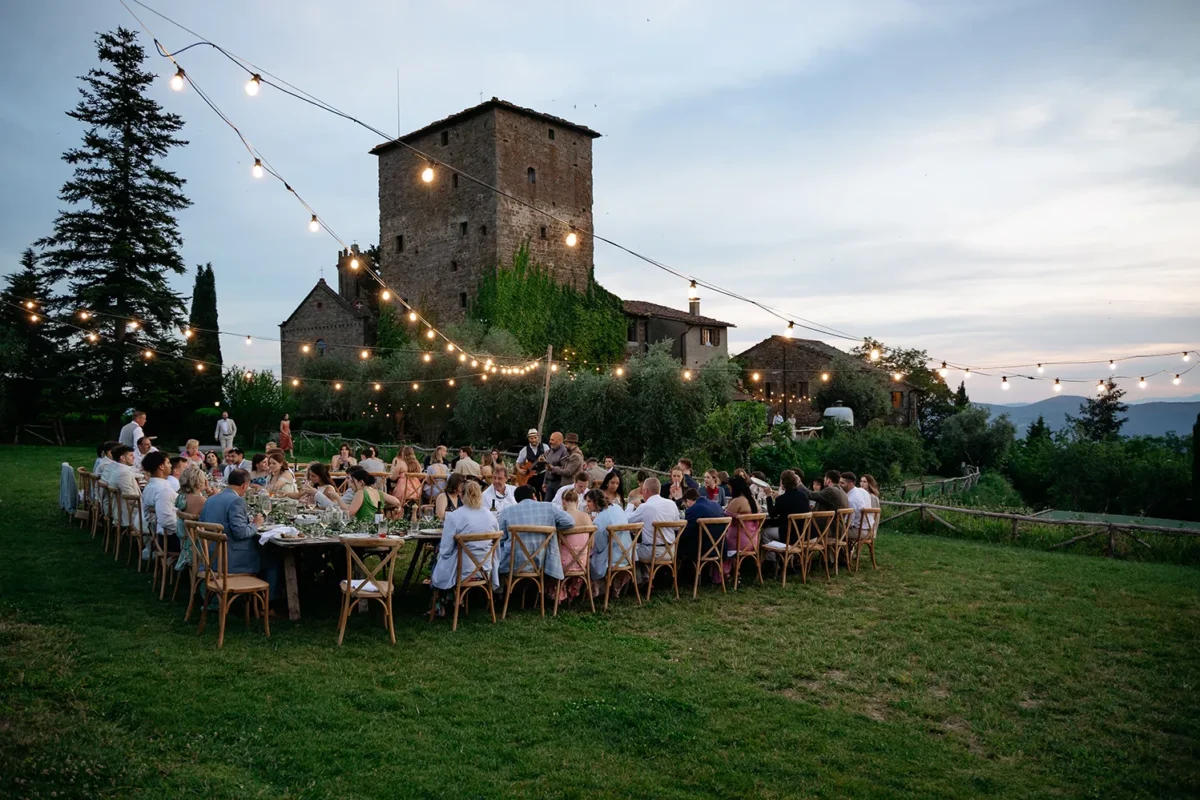
Rome
About 1 hour 30 minutes by train
The capital, layered with almost three thousand years of history, from the Colosseum to the Vatican. Easy to add at the start or the end of the trip, especially if you fly into Fiumicino.
Venice
About 2 hours 15 minutes by train
Romantic, unique and unmissable at least once in a lifetime.
The train arrives at Santa Lucia train station, right on the Grand Canal.
Milan
About 2 hours by train
Italy’s capital of fashion and design, famous for its shopping streets, the Duomo and Leonardo’s Ultima cena.
Bologna
About 40 minutes by train
A historic university city with miles of porticoes, and the home of handmade pasta, tagliatelle and tortellini.
Perfect for a food-focused day trip.
Pisa
About 1 hour by regional train
The city of the Leaning Tower, an easy half day, and convenient if you’re flying in or out of Pisa airport.
Cinque Terre
About 2 hours 30 minutes by train
Five colourful fishing villages clinging to the cliffs of the Ligurian coast, linked by Via dell’Amore , a footpaths with views over the sea.
Trains from Florence reach La Spezia in about two and a half hours, and from there a local train stops in every village.
About 3 to 4 hours
Dramatic cliffs dropping into a deep blue sea, lemon groves and the limoncello made from them. High-speed trains from Florence reach Naples in about 3 hours, or Salerno in about 3 and a half. From there you continue by ferry, bus or private driver to Positano, Amalfi or Ravello, which takes about another hour.
Worth at least two or three nights.
About 3 hours
Grand historic villas with gardens down to the water, and small villages clinging to the steep shores, like Bellagio and Varenna.
Take the high-speed train from Florence to Milan, about 2 hours, then a regional train to Como or Varenna, another hour or so.
From there, ferries connect the villages around the lake. Perfect for two or three slow days after the wedding.
The Dolomites
About 4 to 5 hours
Jagged pale peaks, alpine meadows and wooden mountain villages, a UNESCO World Heritage Site and a complete change of scenery after the Tuscan hills.
Take the high-speed train from Florence to Bolzano, about 3 hours, then continue by car or bus into the valleys, such as Val Gardena, Alta Badia or Cortina d’Ampezzo. Here a rental car makes life much easier. Best from late June to September for hiking, or in winter for skiing.
Booking
How far ahead to book
In Tuscany, the earlier you book, the more choice you have. The most popular villas for May, June and September are often booked 12 to 18 months ahead, and photographers, caterers, florists and planners follow the same calendar. For weekday dates, smaller weddings or the quieter months, six to nine months can be enough, but the best options go first.
The same applies to intimate weddings. Many couples with a small group of guests simply rent a villa or a farmhouse on Airbnb or a similar platform, as Margo and Mason did in Montisi. The most beautiful houses in the Val d’Orcia and the Chianti are often booked a year in advance for the summer, by families on holiday as well as by couples.
If you go this way, check one thing before you pay: whether the owner allows events.
Many holiday rentals don’t allow parties, ceremonies or extra guests, or only with written permission.
Ask clearly about the number of people, outside caterers, music and the latest time for the evening, and get the answers in writing. A wedding that turns out to be against the house rules is a stressful way to start a marriage.
Once the venue is confirmed, book the people who can only be in one place on your date: the photographer, the officiant and, if you need one, the planner.
Flights and hotels for guests can follow, but it helps to share the date as early as possible, especially for summer weekends.
Light
Planning the day around the light
In June the sun sets around 8:50 pm, at the end of August around 8 pm, and at the end of September around 7 pm. The hour before sunset gives the softest light of the day: it’s the best time for portraits and for the aperitivo, with dinner just after.
Midday light in summer is harsh, and outdoor ceremonies without shade are tiring for everyone. Shade, parasols and water make a big difference.
Evening
Music and evening rules
Many venues in the countryside ask for amplified music outdoors to end around midnight, and some move the party indoors after that.
Ask your venue early: it shapes the whole evening!
Food & wine
Food and wine
Food and wine are a big part of a Tuscan wedding.
Expect handmade pasta, local cheeses and cured meats, Florentine steak, and long dinners that go on well into the night.
Tuscany is above all a land of red wine: full-bodied reds, made to age, like Chianti Classico, Brunello di Montalcino and Vino Nobile di Montepulciano.
At many weddings the aperitivo is served with Prosecco and guests often assume it’s a Tuscan tradition.
It isn’t: Prosecco comes from the Veneto, in the north-east of Italy. It’s light, sparkling and served cold, so it works well on a hot summer afternoon, but it has little to do with Tuscany.
If you’d like to keep it local, Vernaccia di San Gimignano is a fresh Tuscan white wine….and for a truly Tuscan experience, don’t fly home without tasting at least one of the great reds from the area where you got married.
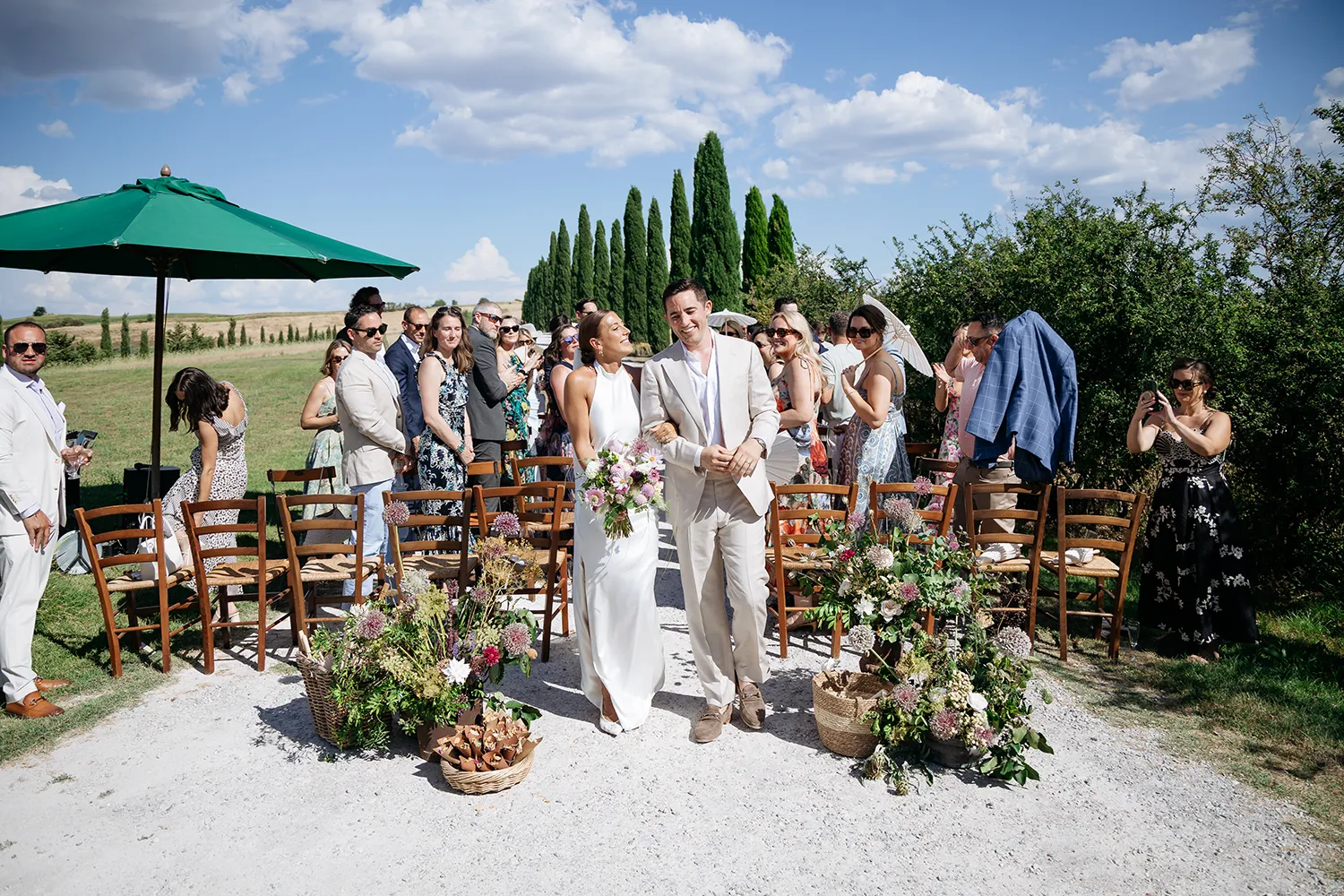
Ceremony
Civil, religious or symbolic ceremony?
Civil ceremony
Legally binding and recognised in your home country. It takes place in a town hall or in a venue authorised by the local municipality. You’ll need documents from your country (usually a certificate of no impediment, translated and legalised) and a declaration at the town hall a few days before the wedding. Requirements vary by nationality: check with the Italian consulate in your country.
Catholic ceremony
In a church, with documents and a pre-marriage course arranged through your home parish. It can be legally valid at the same time.
Symbolic ceremony
The most popular choice for foreign couples. You get legally married at home, and in Tuscany you can celebrate anywhere you like: a garden, an olive grove, a terrace over the valley, with your own words and your own officiant.
Same-sex couples
Italy recognises civil unions, and symbolic ceremonies are always possible.
Jasmine and Lauren celebrated theirs at Villa Castelletto.
A good local wedding planner can save you a lot of time, especially for civil ceremonies and paperwork. If you’d rather plan it yourselves, many villas have their own coordinator who can help with the practical side.
Kind words

“
Really, all you need to know is this: At least 10 people have told us that we had the most beautiful wedding photos they had ever seen and that our wedding looked like a storybook dream.
Jessica & Mattew · Ravello, Amalfi Coast
Something you’d like to know that isn’t here? Write to me and I’ll add it to the guide.
Check my availability
Planning a wedding in Tuscany?
Tell me your date, the area you’re thinking of and roughly how many guests. I’ll be happy to share what I know about the places you’re considering.
RECENT WEDDINGS IN TUSCANY

Il Rigo wedding photographer
Nicole and James, from Connecticut, got married at Il Rigo in the Val d’Orcia: a…

Cortona Wedding Photographer
Chris and Ari came from the USA for a relaxed, joyful wedding at La Corte…
Pienza wedding photographer
Nic and Evelien came from Belgium with their two children to get married at Terre…

Villa Catignano Wedding Photographer
Mia and Michael came from Australia to get married at Villa Catignano, a 17th-century villa…

